**During the last several years we have made many great contacts in the Bigfoot arena and many of these researchers haven't been heard from in many years. North America Bigfoot Search will be reaching out to these great leaders, researchers and asking them to write a column for us explaining their past, where they've been, what they've been doing and maybe their angle on the Bigfoot issue. This will be a section where guests can speak their own words in their own style. Their ideas do not necessarily reflect the policy, procedures or theories associated with North America Bigfoot Search. You will find these individuals well versed in Bigfoot. We thank them for their contributions and we welcome your comments (nabigfootsearch@yahoo.com).
••••••••••••••••••••••••••••••••••••••••••••••••••••••••••••••••••••••••••••••••••••••••••••••••••••••••••••••••••••••••••••••••••••••••••••••••••••••••••••••••••••••••••••••••••
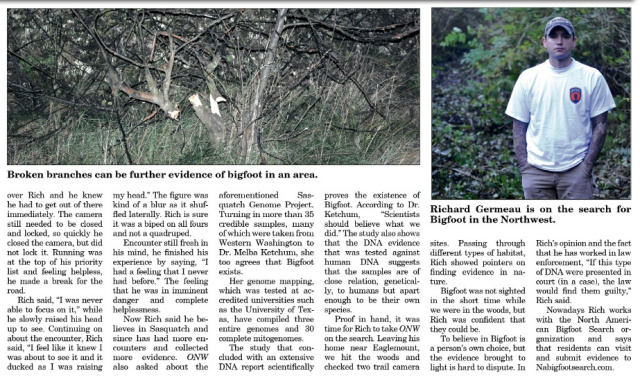
Here is a good interview with NABS researcher Rich Germeau:

••••••••••••••••••••••••••••••••••••••••••••••••••••••••••••••••••••••••••••••••••••••••••••••••••••••••••••••••••••••••••••••••••••••••••••••••••••••••••••••••••••••••••••••
NABS received an email from Ray Crowe asking to post a report he had done on ZANA and the relationship to bigfoot DNA. We believe that this is a very interesting perspective from a bigfoot researcher with decades of experience. Enjoy the report and we hope we hear more from Mr. Crowe!
THE ZANA AFFAIR
This is the incredible story of Zana or Zanya, a hairy Wild Woman, known locally as an Abnauayu, or a really Abominable Snowman…Snow Woman in this case, or to some, called an Alma (female is Almasty) or Kaptar (from Khazakhstan), depending on the location. She is a feral relict hominoid from Stone Age prehistory distantly related to human beings, possibly Neanderthal some think.
The species “Homo neanderhalensis” is not an ancestor of modern humans some research indicates, the mitochondrial DNA studies having shown that our two species have evolved separately. They are descended from a separate branch of the human family tree some 516,000 years ago, according to some research published in Nature Magazine. When modern man moved into Europe about 45,000 years ago, the Neanderthals were pushed into the wilds, supposedly going extinct, as the last known Neanderthal fossils are from 24,000 years ago.
In contrast, Svante Paabo, a paleogeneticist at Germany’s Max Planck Institute determined from sequencing the Y-chromosome from a 49,000 year old Neandertal genome that some Cro-magnon’s possibly invited ladies to their cave for sex, and to have hybrid progeny…as any human who has ancestors from outside of Africa (where Neanderthals never lived) has one to four percent Neanderthal genes in their genetic makeup!
Much of this ongoing Zana saga is based on the publications of The Russian scientists: Boris Porshnev, “The Struggle For Troglodytes;” “A Skeleton Still Buried and a Skull Unearthed: The Story of Zana;” by Igor Bourtsev; and from the popular 1996 book, “In the Footsteps of the Russian Snowman,” by Dmitri Bayanov. Hominologists, later they were considered cryptozoologists…people who study unknown creatures. I have little new to add, but have accumulated much of the scattered published information to assemble this article.
Incredibly wild and vicious, Zana was captured with great difficulty in the forest by a local merchant in (about?) 1850, as was said by Apollon Dumaya, a local official who was told by his father of the capture. It was in the Ochamchir Region of Georgia in a gulch along the Adzyubzha River…and the merchant was astonished to see a young female Abnauyu in a meadow along the gulch living in Paleolithic innocence. Incredibly smart and disappearing a second before capture, she was finally outsmarted…the merchant left some red male underwear at the meadow where she was frequently seen and she was caught while putting the underwear over her head and hips.
Named Zana (means black in Georgian) the creature was tied, and fighting back, was hit with cudgels and gagged with a mouth full of felt and finally shackled by her legs to a log. She was eventually put in a ditch, surrounded by a fence of sharpened logs and was living in squalor. There she growled and charged at laughing children who threw sticks and dirt clods at her. After some time she was finally considered somewhat tamed and then made “love” to…even giving birth to live half-breed children…thus, the strange saga of “The Zana Affair.”
Near the end of the last century, Zana was probably sold as a curiosity to the handsome prince, D. M. Achba, titular head of the Zaadan region of Georgia in the late 1800’s. Achba passed this strange slave to his vassal Chelokua, who apparently sold her to the Nobleman Edgi Genaba who was passing through the region at the time.
Genaba took poor Zana in chains and shackles as a slave to the village Tkhina on the Mokva River where his estate was located, some 48 miles from Sukhmia, the capitol city of Abkhazia and near the Black Sea in Georgia.
She was thrown into a caged stone enclosure sans her chains and ropes, and as she acted like a wild beast, food was simply thrown to her. She dug a hole in the ground where she slept for the next three years. Zana was a local curiosity and surrounding villagers would come by to poke her with a stick, chuckling as she would grab for the stick, growl, howl, and menacingly bare her big glaringly white teeth.
Eventually becoming tame, Zana was tethered in a fenced enclosure near the house under an awning. Over time she became domesticated and was released to roam the hillsides free of shackles. Zana did not roam far though, preferring to remain near her food, but she could not endure the warm rooms of indoor human cultures, and slept outdoors, still in a hole in the ground that she had dug under the awning.
Zoologist Professor Alexander Mashdovtsev first heard of and studied the amazing story of Zana, and with Boris Porshnev, gathered many of the following descriptions from locals who still recalled her.
Zana could not speak, even after several decades of living with humans, had never ever learned a word of the native Abhkaz language. She could only make inarticulate sounds, unexpected laughs, mutters or cries when she was poked with a stick or otherwise irritated. One sound done well was the imitation of a squeaking gate, which seemed to make her happy. She could recognize her own name though, and would do simple chores…like carrying with one hand heavy 110 pound sacks of ground corn flour that she had ground from the water-mill by the river, collecting firewood, removing her masters boots, or fetching water. She was fearful when Edgi Genaba shouted at her despite her huge size, but others were afraid of Zana because she was known to bite, and whenever she came to the house, the women only came near when she was in a calm and gentle mood. Adults told Zana-monster stories to their children to make them behave, although Zana was never known to attack any of them…”Zana’s gonna’ get cha’ if your bad.” Perhaps if she was poked with a stick when free?
Zana had features of both Mongoloid and Negroid extraction, and her whole body was very tall with black or dark gray skin, and reddish hair that covered her body like a mass of felt, while on the head it was described as being tousled and a thick shiny black. The thick reddish-black hair then ran down the middle of her back like an animal mane. She was said to be six and a half feet tall, and had huge red eyes. Zana was also broad and had huge buttocks and pendulous breasts, and was quite muscular and could splay her toes wide. Her hideously broad face with high cheekbones and ape-like nostrils turned forward was pure animal though. The muzzle-like jaws had strong sharp teeth…strong enough to crack bones or nuts with. Also quite athletic, Zana could outrun the swiftest horses, or swim the waters of the swiftest river in flood stage at high tide, and do it all the year around. The nearby wild Mouki River was apparently an easy swim with her powerful arms and legs.
Zana hated clothes, preferring to run around naked, even in the coldest winter which she seemed completely resistant to, and if dressed, would tear the clothes to shreds , though she eventually learned to wear a loin cloth. Strange, as she was captured trying to put on red underclothes. Another strange habit was her curiosity about rocks, spending time stacking or cracking them apart. Often she was seen cooling off by lying in a pond with the water buffalo, or bathing in some icy mountain spring. Zana liked to climb trees, or roam the nearby hills, using a stick to fend off dogs or other perils.
Zana was a glutinous eater, taking anything offered her, like meat or hominy, and eating with her bare hands as she never learned how to eat with a spoon and plate.
Often Zena would be seen to climb trees for their fruit, and would pull down and shred grape vines. She drank wine, enough to get quite smashed, lying in a swooning state and sleeping for hours…and the locals learned to give her wine to make her drunk. Perhaps where the term “Monster Mash” came from?
Zana became pregnant several times, from several different fathers…an important clue to geneticists . The local men had forced her to drink wine, and it didn’t take long to get drunk…and then she became sexually aggressive. And, there was always someone to make love to a monster. During drunken orgies Edgi Genaba was said to offer a prize to the man who would mount Zana, and the prize would always be given to a winner…if even himself.
After the birth of a human-type child without assistance, Zana would take the newborn to wash it in the cold waters of the spring or the frozen waters of the river…the first two hybrid babies quickly died from exposure. Eventually the local villagers would take the babies away from the silly mother, nursing and raising the half-monster babies themselves. This occurred four times…two sons and two daughters, who were reared as human. There was an unconfirmed report of another child that ran off to join with mother’s people in the desolate Caucasus Mountains. Seems doubtful though, as the child had to grow up locally and would have probably been named and described.
The sons were the youngest Khwit, and then Dzhanda, while the daughters were young Gamasa and the oldest Kodzhanar. People had no idea who their fathers were, although many years later during a census taking, the children were listed as offspring of a local resident, Kamshish Sabekia, who acknowledged “winning prizes” with Zana before he was finally married. All four of the children adopted the family name of Sabekia. Zana’s youngest son Khwit and his sister Gamasa were raised by Genaba’s wife. It was rumored that they were both sired by Edgi Genaba himself. All the children were fertile, and left descendents scattered across Abkhazia.
The boys had dark-grayish skin and were said to have normal faces, Khwit having thick curly hair and very full lips. Apparently the genes of the father were dominant, overruling the mothers line of descent.
Khwit could work, talk, and reason like other villagers, had a social life, but was powerful, and belligerent…quick to pick a fight. He often had fights with other villagers. Like his mother, Khwit didn’t like children as they would get into his garden to steal pears and grapes…though not poking him like with mom. Khwit was said to be not only a very strong man but was difficult to live with as he was very violent. Khwit once got into a fight with a relative who jumped him. He defended himself but the relative hit him with a mattock and put a deep gash in his right arm near the elbow. The arm had to be amputated, though he could still do his work on the collective farm. A local official recalls the incredibly strong Khwit plowing his lot with only his left arm. Khwit was also said to be able to lift a man in a chair off of the ground with very powerful jaws. Dzhanda, the other son was quite talented and became an accomplished pianist.
Aging, Khwit moved to the town of Tkvarcheli where he finally died. He lived until 1954 being 65 or 70 years old, and was taken back to be buried near his mother Zana, who had died in 1890, in the family cemetery in Tkhina village in the Ochamchiri District of Abkhazia. Some note the importance of Zana being buried in the family cemetery of the Genabas, as if she were part of that family. During her life, she showed little sign of aging, having no grey hair and retained her teeth.
Zana’s grandchildren were also said to be dark skinned, with Negroid features, and extremely strong, and it has been noted by geneticists that the hybrid offspring of Khwit were viable and not sterile. Khwit Sebekia was married twice, and sired two daughters and a son. Igor Bourtsev located most of Zana’s descendents, although one daughter had been electrocuted the prior year of his investigation. Robert Kukubava granted permission for Igor to reproduce photos from the family album. Daughter Raisa and her brother Shuliko are similar to Khwit with similar lower jaws and protruding cheekbones. His older daughter Tatyana has no resemblance to Zana except for the eyes, though photos of Khwit and his sister bear a resemblance to the description of Zana.
Later, several Russian anthropological expeditions attempted and failed to locate Zana’s bones. Also, it had been difficult to obtain permission to disinter the graves in the cemetery. Fortunately an old Abkhazian colleague was appointed as a local council official and was able to grant the necessary permission. Another official, Apollon Dumava, the former council official recalled that his older relatives remembered Zana, and she was said to have curvy hips that attracted the attention of the local men.
The first expedition was in September 1964 when archaeologist V.S. Orelkin and Professor Boris Porshnev searched but were unable to locate the gravesite in the Tkhina cemetery. Returning again in 1965 they were accompanied by Yury Voronov who later became Vice Premier of Abkhazia (but was killed in 1995). The cemetery was located and was found overgrown with bracken fern, but Khwit’s ten year old marked grave mound was easily found. It was said by the last of the family relatives,70 year old Kenton, that Zana’s grave was under a pomegranate tree. Excavating there, only the remains of one of Zana’s grandchildren that had died at an early age was found.
On the next two expeditions, nothing was found, but in October 1965 the possible remains of Gamasa were located and the skull collected. It was small and had definite features that appeared to be paleoanthropic.
After the passing of Prof. Porshnev, young Igor D. Bourtsev and Dimitri Bayanov led expeditions to the area in 1971, 1975, and 1978. They were unable to locate Zana’s grave either, despite digging in adverse conditions; seemingly endless downpours of rain, and in sticky clay earth.
It was then decided in 1971 to locate and excavate Khwit’s grave which was well marked, and remove the skull. Accompanied by the famous Professor of paleontology Nikolay Bourchak-Abramovich assisting with their spade work, Igor Bourtsev excavated the easily located grave of Khwit, removed the skull and took it to Moscow with the other skull that was located. The skulls are now believed to rest at the Moscow State University Institute of Anthropology.
Igor D. Bourtsev, later becoming a cryptozoologist studying unknown species, took the exhumed skulls to Moscow for study of their modern and ancient features. The results from the Khwit skull were published at the Relict Hominoid Research Seminar and the Moscow Naturalists’ Society in 1987, coauthored with M.A. Kolodieva, as “Results of a Preliminary Investigation of a Skull from the village of Tkhina, Abkhaz ASSR” (in Russian).
Physical anthropologists M. A. Kolodieva and M. M. Gerasimova found that the skull was larger than normal male skulls from the region in the collection of the Moscow State University Institute of Anthropology. The facial section of the skull was significantly larger than typical Abkhaz types…the superciliary cranial contour being grater than the maximum of some fossil skulls, and are compared to the Neolithic Vovnigi II skulls of the fossil series at the Institute. It was also noted that the back of the cranium is of the “Homo sapiens” type, without a knot, and that the brow ridge was also of a normal size and had little marking. It was mentioned that the brow ridge of Khwit was even larger than that ascribed to Zana, the supposed Neanderthal…possibly as it was from a male. The overall peculiar features of the skull were also noted in the greater development of the skull’s two foramina mentale of the lower jaw (circular opening in jaw), the intrusive bones of the sagittal suture (across front to back, joins two side parietal bones), and the inca bone (separate skull bone often found in Inca mummies). Gerasiomva, suggests that the skull should have a more detailed study.
Another female skull was unearthed also at the Tkhin cemetery. The skeleton was buried on its side with the legs bent next to Khwit’s grave, with a mirror at the head indicating that it was female. The skull was more robust than that of local women, and was noted to have a large projecting jaw. In the grave was found a rubber shoe branded 1888. From the date, this was assumed to be Zana, and was extremely exciting to researchers, as this would be the first time they had found the remains of an Abnauayu, or Almasty. Except…the anthropological analysis indicated that it was from a black woman who had somehow made it to the Caucuses…now what?
Next, a DNA check was due after the August 2006 Russian newspaper Komsomol’skaja Pravda had an article on the skull examinations from the supposed relic Almasty. Igor Bourtsev was invited to have both skulls analyzed during a visit to the US, and Bourtsev replied on the Mugamir Russian website that he had visited New York July 13th through the 20th (2009) when the DNA of the skulls was examined by the New York University. The results were made public on the National Geographic program, “Is It Real? Russian Bigfoot.” Bourtsev was interviewed and talked with a U.S. geneticist and an anthropologist. The idea was that Zana and her son Khwit were actually Neanderthal hybrids with similar genomes that had possibly survived into modern times, especially now that the entire Neandertal genome has been sequenced and examined by the Max Planck Institute’s Svante Paabo and his team in 2009 in Leipzog, Germany.
Bourtsev said that the examination revealed that one of the skulls was of an Australoid type, possibly that of Khwit, and that the other female skull was of a completely unrelated African type…definitely not that of Zana. The visiting anthropologist said that even though there was a similar DNA relationship between the two skulls, the female skull showed many distinct morphological differences, like a strongly defined lower face and tooth prognathism (stuck out).
Unfortunately for some of us Bigfoot fans…the mitochondrial DNA that was analyzed by the geneticist Todd Disotell from both of the skulls indicated that the shared female maternal relationship was of a human origin…not mutations of the supposed Neanderthal species, as Bourtsev thought, closing a thirty year debate between often belligerent cryptozooligsts. The skull of Zana is still missing, so there is still hope!
This whole Zana Affaur tale reminds me of the popular novel “The Mammoth Hunters” by Jane Auel, telling of the young girl Ayla, living and reproducing hybrids with Neanderthals. I don’t recall if the human genes were dominant over the Neandertal.
I wonder if Zana’s ghost is still searching for her son’s missing head and haunts the local villagers? It is said that Igor Bourtsev while digging through the muck took seriously ill with a strange disease that doctors were unable to diagnose.
Summary
So, what is Zana anyway? Ape, primitive man, or human? It is said that chimpanzee DNA is 98.5% human…not much room to squeeze the Neanderthal, australopithecine, Alma, Sasquatch, and other primitive types between. Most Bigfoot scientists say the creature is an ape, based on the fossil bones of an ancient ape, “Gigantopithecus blacki.” They stick to the idea almost religiously and won’t compromise much. Many Russian investigators have long opted for the Neandertal as a viable model. Perhaps the creature is an ape only in the sense of Desmond Morris describing humans as “The Naked Ape”…then we also are apes along with Sasquatch. Keep in mind that the great apes have 48 chromosomes, while humans only have 45.
The clues lie in the structure of the DNA molecule and the hereditary traits…Zana could give birth to living human types that have grandchildren. There have been a total of 10 cases in Russia or China from 1912 to 1954 of other live births from wild women.
Hotly denied some, more recently, DNA researchers, as opposed to Bigfoot researchers, think that Almas and the North American Sasquatch are human. And that the Sasquatch, Yeran, Kaptar, Yowie (Australia), Yeti, and Mapinguari (Amazon), plus the Alma, are all closely related cousins. My first personal thoughts were of a “Homo erectus (Neanderthal is a descendant of them)” for a model of the Bigfoot that had evolved to different forms in different environments, which even is how Darwin explained the variation in species from Galapogos specimens and observations. Note, the Neanderthal separated from “H. erectus” some 600,000 years ago.
But some few of the scientists thought the often ape-like and often human appearing creatures were probably a form of human, very similar to us. My first exposure was from the geneticist Dr. Ruth McFarland in 1995 who presented evidence of the Washington State Bigfoot as being human at a Carson, WA, conference.
More recently, I have time and again run across DNA evidence that suggested human…but at the time, to the scientists involved, all were “contaminated!” Even a sample I provided from the Zac Cave in Idaho was said to be contaminated.
The Coy/Green Tennessee hair samples are a prime example of where some scientists began to see the light. Dr. Henner Fahrenbach tested a hair taken from the wrist of a Bigoot named Fox, and declared it to be human. Bob Daigle, a friend of Mary Green’s sent a hair sample to be tested for DNA by a geneticist (named only as Dan) who found nothing but human results, the sample sequence being an exact match. He sequenced 300 nucleotides from a mitochondrial gene called clytochrome b, and amplified a 1100 base pair fragment, then ran results against the GeneBank database…human.
Control tests were run that were deliberately contaminated with dog and cat DNA…despite which still the Fox hair sample ended up testing human.
The rest of the general scientific community and senior Bigfoot researchers deniability is reaching the point of being ridiculous. At some point, some very public agency or noted personage is going to declare that the creatures are actually human beings…just different from modern man through a subtle shift in the genetic code. Perhaps just a few genes are involved…though important ones, and they need to be identified.
Once that point has been achieved, perhaps we can gain valuable insight into what the tiny genetic variations are between us and Zana. Those that add up to huge differences…maybe even the solution as to what caused the jump to “intelligence” in Africa some 200-140 thousand years ago when there was a giant intellectual break between “Homo erectus” and modern humans. The answer to why we are US.
Ray Crowe Oct 31, 2010
Sources
http://www.bigfootencounters.com/articles/argosy71.htm
http://www.bigfootencounters.com/articles/truefrontier.htm
http://paranormal.about.com/library/weekly/aa022800b.htm
http://www.hominology.narod.ru/zanai.htm
http://www.isogg.org/ancientdna.htm
http://phantomsandmonsters.wetpaint.com/page/Villagers+Remember+Descendants+of+a+Bigfoot
http://www.bcscc.ca/almasti.htm
http://www.cryptomundo.com/cryptozoo-news/khwit-dna/
http://skeptoid.com/episodes/4040
http://www.cryptomundo.com/bigfoot-report/russian-bigfoot/
http://www.cryptomundo.com/cryptozoo-news/x-woman/
http://www.newscientist.com/article/dn18869-neanderthal-genome-reveals-interbreeding-with-humans.html
••••••••••••••••••••••••••••••••••••••••••••••••••••••••••••••••••••••••••••••••••••••••••••••••••••••••••••••••••••••••••••••••••••••••••••••••••••••••••••••••••••••••••••••••••••••••
NABS Interview of The Bay Area Bigfoot Group Co- Founder Warren Thompson
The Bay Area Bigfoot Group
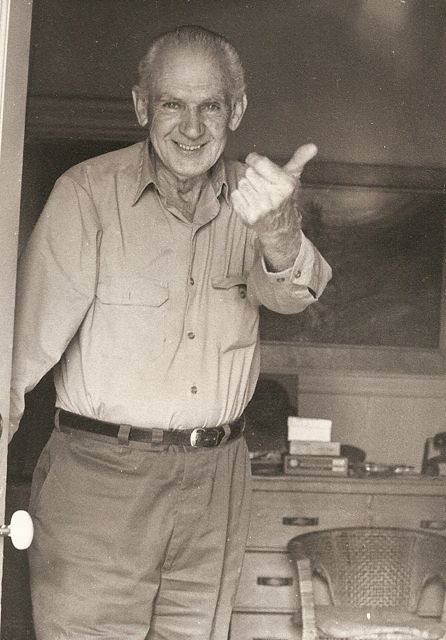
George Haas- Photo Above
In the mid 1960’s a group was starting to form in the San Francisco Bay Area where their sole interest was Bigfoot. The formal organizer of the group and the “Head Honcho” was George Haas. George at the time was living on the Oakland/Berkeley border and had just retired from a career near Calaveras Big Trees in a job working in the outdoors, ranger type work. Even though George was getting up in his years, George had the uncanny ability to relate well with all age groups. He had college aged adults and older Bay Area residents forming around him to research the Bigfoot phenomena. The co-founders of the group were Archie Buckley, Warren Thompson and Joel Hurd, all Bay Area residents and all in the general age categories of George. George never married and didn’t have any children. When Archie died, he passed on his personal research to Warren Thompson, the last living of the Bay Area residents.
Warren Thompson
Archie Buckley’s widow, Rhea put NABS in contact with Warren. He currently resides in the Bay Area and lives with his best friend, Markey, his pet dog. Warren, like George, never married, is 67 years old, has one sister and does not have children. Warren was raised in the Menlo-Atherton area in his younger years and graduated from Menlo Atherton High School. Warren spent over 30 years working for the County of San Mateo. He was born in San Francisco and raised in the west bay. Warren did attend college briefly but decided that wasn’t for him.
In 1969 Warren was taking a motorcycle ride to Willow Creek, CA. Warren saw a small shack in the middle of town with a man showing a short movie for fifty cents per viewing. He walked over to the shack to see what was being shown and found there was footage of a hair covered biped walking across a creek bed. The man charging the fifty cents was described by Warren as gruff and curt. Warren was mesmerized after paying the first fifty cents and flopped down another two quarters for another viewing, Rene’ Dahinden took his money and showed him the Bluff Creek footage one more time. Warren was now hooked on Bigfoot.
People in Willow Creek told Warren that there were casts of Bigfoot footprints at Hodgson’s Variety store, Warren walked over. He went into the store and met Al Hodgson. Al showed him the casts and they had a short conversation. Warren told Al he was from the San Francisco Bay Area and Al told him he needed to speak with George Haas, Al gave him George’s phone number. Weeks later George and Warren spoke and a meeting was organized in the Yolla Bolly Wilderness. Shortly after Warren’s first meeting with George he met other members of the group and then after they formed the Bay Area Group. George later produced “The Bigfoot Bulletin”, a monthly newsletter about Bigfoot.
After the forming of the Bay Area Group, the team spent countless days in Northern California deep in the mountains conducting their research, many of the findings are in the Bigfoot Bulletin (See the “Bigfoot Bulletin” page on this website).
Warren explained that Archie Buckley was another co-founder of their group. He said that Archie had special training on footprints, the mechanism and movement of the foot and lower body and this expertise did aid their investigations. Archie was someone who loved the outdoors and spent many hours with the team in the Trinity County Region. Warren said that Archie did claim one sighting in 1971. Warren explained that their group had a special chemistry where all got along well and all were dedicated to their research mission, Bigfoot
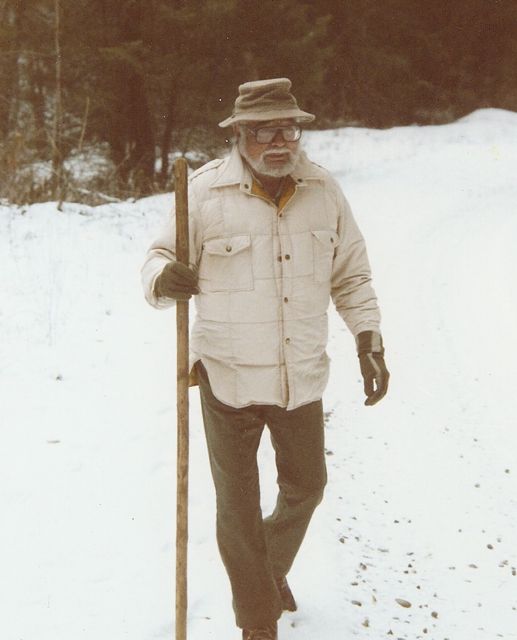
Photo Credit- Rhea Buckley- Vintage 1970
In the early 1970’s the Bay Area Group focused much of their research effort in Trinity County and much of that effort in the Yolla Bolly region. Warren stated that on one trip the group was deep into the region off Highway 36 and all members were in attendance. It was approximately 5 am on an October morning when Warren states he was shaken awake by a team member and told to wake up and listen. Warren stated he heard a low scream slowly rise in pitch and volume for 8-10 seconds. He heard this scream 5-6 times. He states that the entire team was mesmerized but they knew tracks had been seen in this area in the past, thus the reason they were onsite. Warren said that the volume that this scream eventually reached was unbelievable. Warren grabbed his recorder and ran closer to the sound in an attempt to get it on tape, as he got closer, the screams stopped, he did not get it on tape. The entire team agreed that any animal known to live in the forests of Northern California did not make the scream, they believed they heard Bigfoot.
The Bay Area Group and the Canadians
Warren stated that early in the research of Bigfoot, their group started to realize that this biped was much smarter then any living animal in the forests of North America. They interviewed dozens of witnesses with many explaining that the biped had a human face and mannerisms. The Bay Area Group slowly started to formulate a belief that Bigfoot should never be shot or captured. Warren says that they soon ran straight into the wrath of Rene’ Dahinden and John Green, both advocates of killing a specimen for scientific reasons. Warren explained that Green and Dahinden played Bigfoot politics and continued to push the agenda that Bigfoot was an ape and one needed to be killed, and, part of the effort, per Warren was a stream of articles and appearances continually pushing that agenda. Warren stated that there was immediate friction between the Bay Area Group and the Canadians (Green and Dahinden). As time went by, Green and Dahinden attempted subtle intimidation of Haas and continued their political campaign for killing and capture. Warren states that the Bay Area Group never understood why the Canadians were so adamant about killing a specimen or how they could justify their position that the biped was ape in origin, this never made sense to the Bay Area Group. As this portion of the interview was starting to close, Warren reiterated that the Haas group and the Canadians were on opposite ends of the belief scale in regards to Bigfoot/Sasquatch and the Haas group could never understand the underlying rationale that existed in the Canadian belief system.
Warren Thompson has stated that his days of researching Bigfoot are over. He was impressed with the presentation that NABS gave to him on our research. Many of the NABS findings parallel the results of The Bay Area Group even though NABS has had no visibility to their findings until the last few months. It is quite remarkable the findings, results, research and interviews that the Bay Area Group was able to complete by a group of weekend and part-time research. The only full time member on the task of Bigfoot research was George Haas, and, he was in the woods for sometimes months at a time. Congratulations to all of the members and associates of the Bay Area Group, their research will live in the years to come on our website via “The Bigfoot Bulletin. Many thanks to Warren Thompson for his insightful interview.
•••••••••••••••••••••••••••••••••••••••••••••••••••••••••••••••••••••••••••••••••••••••••••••••••••••••••••••••••••••••••••••••••••••••••••••••••••••••••••••••••••••••••••••••••••••••••••
David Paulides’ Interview With John Green
This interview took place in late 2007 with the assistance of Al Hodgson. NABS had specific questions they wanted Mr. Green to answer, he answered everything we threw at him. Mr.Green was the consumate gentleman and is a huge assett to the Bigfoot community. What follows is a summary of the interview and his answers:
John Green
There are only a few people in the Bigfoot community who have conducted research as long as John Green. During our early stages, NABS purposely took a stealthy approach to the entire Bigfoot arena and if it wasn’t for a very positive recommendation from Al Hodgson, and other researchers, we may not have ever had the opportunity to speak with Mr. green. He has written several books about Bigfoot, is a retired newspaper owner, journalist and still is on the Bigfoot research front lines. It was a huge honor to speak with John and have him answer some very finite questions about Bigfoot.
My conversation with Mr. Green was initiated because a mutual friend offered to broker a conversation. Al Hodgson had just returned from a vacation to Yellowstone National Park and heard about the controversy brewing over the Bluff Creek video and the discussion about a Bigfoot possibly being shot. Al had stated that I should talk with John, as he was involved in the footage from the time it arrived in Yakima, WA.
I called John on a Sunday afternoon at his home in Harrison Hot Springs, BC, Canada. John is just over 80 now and Al had advised me that John was having medical issues with his wife, so was Al. I had always heard that John was a very soft-spoken, mild mannered man who listened as well as he spoke and he was a person who seemed to get along with everyone. His background as a newspaperman and owner of a newspaper made him someone that knew how to get to the bottom of facts and someone who could stay with a story over a prolonged period of time.
John was very happy that I called and stated that Al had said many nice things about me. He stated that his memory had started to slip in recent times and he may have to refer to his notes for some answers but that he’d do his best to answer my questions. I first told John how much I admired his passion for Bigfoot and his ability to collect over 4000 sighting reports and keep them computerized. He said that he was actually in the process of having his information placed in a complex database that anyone could search on the internet. He said that it would be an easy search and that it could be accomplished many different ways. John explained that there were many databases on the web for Bigfoot sightings but none could be searched and siphoned for information, his would be the first. A company is doing the work and it was targeted for completion at the end of May 2008 but as of November 1st it had not been finalized. John’s best guess on when it would be completed was still unknown. At the present time all of his sightings data is on a DOS based computer system and is very user-unfriendly, per John.
One of the first items we spoke about was the possible migration of Bigfoot. I explained that I had heard conflicting theories about Bigfoot and their migratory patterns and wanted to know if his data had any supporting information in either direction. John explained that most animals go south in the winter and north in the summer, except Bigfoot. He explained that there weren’t any clear indicators that Bigfoot did migrate but any information about migration showed that they went north in the winter and south in the summer, a confusing twist to an ever confusing story.
Another hot topic for Bigfoot researchers is the size of a region that a Bigfoot may roam? John was asked if Bigfoot is confined to a specific region or do they randomly roam huge areas? John interrupted and said that there is absolutely no evidence to show that Bigfoot stays anywhere for any period of time. If there were evidence then researchers would be able to confine their efforts into one area and learn something about the creature, which they cannot. Mr. Green said that there was only one case that exemplifies that the creature had any path that was consistent over a long period of time.
There is an area on the Nooksack River where the sockeye salmon return every four years. Locals had called to report Bigfoot sightings every four years that were in synch with the return of the salmon. The locals had stated that they had seen Bigfoot crossing fields, roads, streams, all heading in the direction of the river and a location where the salmon were easily harvested by the hominid. It was determined that in 1967 and 1975 were the biggest years of Bigfoot/Sasquatch sightings and these coincided with the return of the salmon to the river.
Since we were talking about rivers, I explained to John that we had completed an extensive mapping of 350 sightings across Northern California. The map showed that 80% of the sightings occur in a 10-mile radius of three major river systems in Northern California. I told him that we had a hypothesis that Bigfoot uses the rivers as a transportation mode to make their way to the coast, probably at night under the cover of darkness. I asked him if he had ever heard of anything similar to what we were proposing. John’s response was a quick, “yes”. He said that it was obvious from his data that Bigfoot likes to stay near rivers and lakes. He said that the Lummi Indians of British Columbia believe that the rivers are the Bigfoot’s freeways. They routinely see the hominid in the water catching fish and swimming from location to location.
The conversation now shifted to Bluff Creek in Northern California. John explained that he had made at least three trips to the area in the early 1960’s. On one occasion he and Rene’ Dahinden were on Lonesome Ridge above Bluff Creek when they saw hundreds of Bigfoot prints that exactly followed the ridgeline. John had brought a cast with him from a BC Bigfoot and he said that his cast was very close in size and dimensions to the prints they were seeing above Bluff Creek. John Green states that there is no way anyone could’ve faked that many casts in that area because nobody knew he’d be there.
Two areas that most Bigfoot researchers refuse to investigate is UFO related sightings and government conspiracy theories. I asked John if he had ever had Bigfoot reports in conjunction with any aerial phenomena, the answer was “no”. He then followed up by stating that “if I felt that Bigfoot was in anyway related with UFO’s I wouldn’t have anything to do with it”. He then stated that “I don’t think my government or yours has any information about Bigfoot that we already don’t know”.
Our conversation merged into talking about the human factor and how that related to Bigfoot. I explained that there are many members of the public that ridicule the idea of a Bigfoot being alive in our forests and refuse to entertain the idea that it may be feasible that they exist. John said, ”There is no logic to the human attitude to this thing. Ray Wallace can’t still be making all of these tracks.” Green’s thought is that certain members of the public still believe that all of the large human looking tracks discovered in almost every major forest in the United States are forgeries, or, the entire story is fabrication. Ray Wallace is a famous person in Bigfoot circles for making giant footprints in an area where Bigfoot was known to roam, but, that was for a very confined period of time in the 1960’s, he is now deceased. Green’s other implication is that there are thousands of Bigfoot sightings from people of every race, sex and nationality and both Native American’s, foreign nationals and everything in between. How could all of these people be fabricating a story? How could they assist in a forensic drawing and have the drawing be almost identical to other drawings from people they have never met?
I changed direction again with Mr. Green and asked him about a long-term question that has lingered in the Bigfoot world; does Bigfoot bury its dead? Green stated that he has no reason to believe that Bigfoot buries bodies. He said that he hasn’t had any credible reports that support this allegation but he has heard stories, as have I. There have been reports of Bigfoot standing in the middle of a river holding a smaller and obviously deceased Bigfoot. The hominid puts a body on the water and then placed huge boulders on top of the body to keep it submerged. This is probably a modern day myth and I’ve never had the story substantiated. The other story that exists involves Bigfoot digging a hole, places the deceased in the grave, fills the hole and then places huge boulders on top of the buried body, again, never substantiated.
These stories persist as different groups reach reasonable answers in an attempt to rationalize why there has never been a Bigfoot body discovered. It’s sometimes difficult for people to believe in something without a rational explanation for every aspect of the hominid’s lifestyle and subsequent death. I believe that if more researchers spent time looking in small caves, crevasses and cracks in large rocky areas of wilderness areas, a body or bones would quickly be discovered. These are areas that are difficult to get to, harder to find and dangerous to search. It takes a researcher in excellent physical condition, an open mind, stamina and a support team to allow them to repel into some of these obscure areas, not an easy position to fill. Green did comment at the end of this section that he isn’t claiming that Bigfoot absolutely does not bury its dead, it might, but he hasn’t seen proof.
One question our group is always asked is where do we believe exists the best opportunity to view a Bigfoot, set trail cameras or setup for long-term research. This is truly the million-dollar question. There has never been long-term or even short-term consistent surveillance of any Bigfoot. There have been accidental encounters where both the human and the Bigfoot were shocked to see each other. I asked Mr. Green that if he was 40 years old and had unlimited resources, where would he set-up surveillance on Bigfoot and how would he go about studying the region? John Green is a very careful individual with his answers and he paused before answering this question. He stated that he’d find a coastal zone with few people and find a point that had a wide-angle view of a small bay and beaches. He would mount cameras to have a complete view of the bay and transmit continually with night vision to watch the comings and going of Bigfoot to the water. This is an interesting response on several fronts. The idea of setting up on a beach is appealing for the ability to view wide angles and big distances. You could pick a beach that has significant exposure during a minus tide when Bigfoot may come out looking and searching for clams, muscles kelp and other animals. You could place the camera at such a distance that the sounds emitted from most trail cameras would not cause the Bigfoot alarm. The mere sound of the ocean may drown out any of the trail camera sounds. I would extend Mr. Greens theory one additional level and state that the same theories may apply to some large river systems, the Columbia River near the gorge may also be an ideal location because of its exposure and the theory that Bigfoot regularly enters the river in this area to catch fish. There are other large rivers in Oregon, Washington and California where the same principles may apply.
Technology has now evolved to where remote cameras could be employed in very isolated locations with the aid of solar power and antenna’s to transmit a constant signal. Couple the signal with a recording device programmed to alert when there is specific motion and you have yourself a viable Bigfoot Cam.
Grizzly bears have been extinct in California since the early 1900’s and there’s never been a definitive reason why they disappeared. There were thousands of square miles of open space and wilderness areas with no people. There was adequate food source with little direct pressure from hunters to cause their disappearance. Our organization is regularly asked if Bigfoot had any impact on the grizzly disappearance? I posed the same question to Mr. Green. John stated that both creatures are predators and routinely try to avoid each other. He says that they have successfully thrived in British Columbia and they know they are a danger to each other and must avoid a confrontation in order to avoid injury. He says that he doesn’t have a credible sighting of a Bigfoot and a grizzly attacking each other and would doubt that Bigfoot had any impact on the numbers of grizzly in California.
The most famous film footage of Bigfoot to date is the 1967 Patterson-Gimlin film at Bluff Creek. I asked Mr. Green what his feelings are regarding the film, its authenticity and the creature depicted. John stated that there is no doubt the film and creature is genuine. He explained that he received working copies of the footage from Rene’ Dahinden and also received some second-generation footage. One of the main concerns in the late 1960’s was the viability of a film crew to develop a costume with the high level sophistication in 1967. He explained that he is the one that took the footage to Disney Studios, previewed the film with them and asked for their opinion if they, or anyone could’ve developed a costume of that quality seen in the Patterson-Gimlin footage. Disney flatly stated that there was nobody in the world in 1967 that could’ve made that costume. They told John that they were the most advanced costume designers in the world in the late 1960’s and there was no possible way they could’ve done it.
John is an absolute wealth of Bigfoot information. He explained that his 4000 index sighting cards are placed on a “DOS” computer system that is very cumbersome. He stated that his daughter is working with an outside company to have the system completely overhauled into a user friendly version and that will be done soon, he hopes. John is doing this with his own money and on his own time. He constantly makes public appearances without compensation, assists new researchers by donating his time and generally is a friend of many in the Bigfoot community. I extend a sincere “thank you” to Mr. Green for his endless devotion to Bigfoot issues and assistance to researchers.
David Paulides
••••••••••••••••••••••••••••••••••••••••••••••••••••••••••••••••••••••••••••••••••••••••••••••••••••••••••••••••••••••••••••••••••••••••••••••••••••••••••••••••••••••••••••••••••••••
Our second guest columnist has been in the Bigfoot arena for over 4 decades. He was the founder of the International Bigfoot Society and was the editor of the "Track Record Newsletter" for almost 20 years. It is our priviledge to host Ray Crowe and his update.
August 16, 2008
Western Bigfoot Society—Ray Crowe
The question is often asked of how I got involved with Bigfoot, and why was the Western Bigfoot Society created.
In the 1990’s I ran a small used books shop in North Portland. One of my customers, a Native American, Roy Caddy, came by one day and told me of a group in Vancouver, Washington, that was interested in this mythical creature, and people actually got together and actively went in search of it.
At the time, I had been interested writing a short story for Dime Novels, where large amounts of financial inducement were offered. My friend, Roy Caddy, commented that the Vancouver group had several ladies, some quite attractive, a charismatic president, and an older bearded mentor, the late Mr. Datus Perry, that was somewhat of a legend himself.
I thought at the time that here might be a good plot for my short story, and when Roy Caddy invited me to a meeting of the Vancouver group, I jumped at the chance to meet these interesting people who chased after myths.
The meeting assembled (I’ve long forgotten what they named themselves), and the serious members discussed the problem of “Kill or No Kill” options, and if they should carry firearms into the field. As it turned out, it was a tie vote, and it was finally voted to carry a rifle in the trunk of the vehicles.
They were having a field trip two weeks from then, and asked if I would care to join the group. I, of course, assented, and asked details on where and when to meet…at the presidents home at 8 AM.
The following weekend, to gain a better perspective of what this short story would be about, I took a trip into Skamania County, WA, where I could get some details to add to my short story; what kind of plants were to be found, both for cover and for a large creature, like Bigfoot, to eat. I found several berry types, ferns, huge and massive cedar and Douglas fir trees, and was able to write down details about the deep woods. My wife and I, along with my granddaughter Mallory, 8, drove into the much higher elevation area of the Horse Heaven Wilderness area, north of Carson in Skamania County. Snow was still thick on the ground, but trails were open. So, Mallory on my shoulder, we explored the woods, looking for huge tracks of a mythical beast in the snow. We found nothing, but was able to conjure up several scenarios of a monster living in the area.
The following weekend I met with the Vancouver group and we started north in a caravan of several cars. Our destination, the Yale Reservoir, wasn’t too far away, but we took a long route up into the hills, stopping frequently to look at wildlife, or a pile of poop of some critter alongside the road.
At Siouxon Creek, we made evening camp. While there was still light, the president showed me what to look for; hairs on trees that were not deer or elk (several trees had the grey hair stuck to them along game trails), trees broken above eight feet, apparently a mark of some kind; and footprints, often huge, and spread well apart as the giant creature strode through the countryside.
That evening, the beer came out, the group got plowed, and I retired to the camper on my truck, rather disappointed with the group. The next morning, one of the group came down the trail early, armed with a bow and arrow. He shot an arrow straight into the air for some reason. I retreated to my truck. Then the group assembled to go chase a Bigfoot…in their cars. A call blaster, a speaker mounted on the lead vehicle, was supposed to attract the creature as they rode up and down on mountain roads dressed in camouflage gear.
Horrified, this was my last trip with this group. I declined when they wanted me to join them on their drive… I was a naturalist, with thousands of hours in the woods collecting insects, fossils and minerals, plants, or photographing scenery. I said I’d wait near camp and search the area…I was still looking for material for my short story.
The group wasn’t gone for more than ten minutes when I found what looked to be huge tracks in the dried mud alongside the road. In one of the several tracks, there appeared to be indistinct toe marks. They measured eight feet apart, so I marked and photographed them. Exploring further, I found a heavily used elk trail. At the roadside, where it would be easy for a creature to see in dim light the underside of leaves, alder trees had been broken…about eight feet up. I descended the elk trail…looking and feeling foolish, as with magnifying glass, I examined the sides of cedar trees for hairs. Lots of them were found, as expected along an elk trail. On one tree though, there was this strange hair. Reddish in color, and over eight inches long. I carefully bagged it and put in a baggie to show the group. Going back to the tracks, I took a small box of plaster of Paris, intent on making a footprint cast. I dumbly mixed the plaster way too thin, and it simply flowed down the gutter, leaving a white outline.
The group returned. Happy that they had routed a small herd or elk, but no Bigfoot creatures. I showed my finds to the president…and he agreed that the tracks might be of a Bigfoot. When I told him I was keeping the hair, he got downright hostile though, and that was the end of my association with the group…except for my friend, Roy Caddy. As it was so easy to find the evidence of the tracks, trees and hair…I guessed I might have been duped. Except…for their strange reaction to the finding of the red hair.
The next weekend, still interested, but dubious, I agreed to go with Roy and another friend into the Clackamas River drainage east of Portland, OR, on another Bigfoot hunt. We ended up in an area near Indian Henry Campground, where along a trail lined with black raspberries, I found near an elk trail, curious holes in the ground where fist sized rocks had been pulled up…no sign of them. Nearby was another elk trail. The books on Bigfoot suggested that sometimes the creatures threw rocks at their prey. Another clue?
We spent most of the day wandering in the brush…crushed ferns, a game bed? A hollow under fallen logs, another sign? Moss disturbed by something moving, another sign? Or just all just probably elk sign? Back at the camper, dripping with sweat on the hot summer day, in the dust of a dried puddle, there was the perfect imprint of a human foot, but the size of a child. Had something been checking us out while we were supposedly checking them out? There was no reason, like fishing, toadstools or fern frond hunting for a small child to be in that particular area. Here again though, I had others with me in the search…I still could be having the wool pulled over my eyes.
A week later, I went back to the same area…only by myself this time. I explored an elk trail running through the woods. And…there it was, a 16 inch track with toes showing on the side of a bank. I tried to plaster it, but the angle was too steep, and it never turned out. But I was turned…finally convinced that there was something to the Bigfoot legend I had been reading about in several softback books in my book shop.
Roy Caddy was not satisfied with the Vancouver group either, and suggested that I start a group of my own. As it turned out…the bookshop had a very large basement that was unused. Roy and friends offered to do the redecorating, painting, and such. My father put some lighting in, Roy made an interesting podium, and one of our first “members” bought 50 folding chairs at a church garage sale…we were in business. Our first meeting featured speaker Datus Perry with his eight-foot tall Bigfoot cut-out creature. There were many, many interesting meetings thereafter.
The rest is history. The name Western Bigfoot Society was the first thing to come to mind. Every group needs a newsletter, so the Track Record was conceived. I wrote it on my old desk computer…cutting and pasting. Later a website was introduced by Mr. Henry Franzoni.
Later, we took our first of many, group field trips, with about ten, to the Ape Caves near Mount Saint Helens in Washington on a field trip. This started an annual tradition of the Cave Crawl that was enjoyed by many members. Also, there was an annual camp-out in Carson, WA, with a multitude of interesting speakers.
And…the society lasted until 2008, having had at a maximum 250 members worldwide…so many in distant countries that the name of the society was changed to the International Bigfoot Society, where a website under the same name still exists. Due to personal reasons, I retired in early 2008, and gave up the society 501(c)3 status, mostly instigated by Mr. Peter Byrne. The vice president, Patty Reinhold, still holds occasional meetings of the now small group.
••••••••••••••••••••••••••••••••••••••••••••••••••••••••••••••••••••••••••••••••••••••••••••••••••••••••••••••••••••••••••••••••••••••••••••••••••••••••••••••••••••••••••••••••••••••
July 16, 2008 Our first guest columnist is an icon in the Bigfoot world. He was one of the first researchers to put a formal investigative group together and lead expeditions to understand and research Bigfoot. It is our extreme honor to welcome Peter Byrne....in his words...
SOME THOUGHTS ON THE BIGFOOT MYSTERY BY PETER BYRNE Some of you, reading this, will recognize my name, in that it has been associated with the Bigfoot phenomenon for some forty-seven years, since December, 1959, to be exact, when it all started for me with a cable I received at the Royal Hotel in Katmandu, from my friend, the great explorer, the Texan, Tom Slick, inviting me to come to the U.S. to design and lead a project of investigation into the mystery. My brother, Bryan, and I, had just concluded three years in the high Himalaya, hunting for the Yeti-expeditions sponsored by Tom-and had just come down from the mountains and were resting up in the capital. The cable informed us that we were to close down our operations, that the time had come to try something else. To wit, a Bigfoot research project in the United States of America. The wording of the cable, apart from the surprise of the invitation, was, I have to admit, at first viewed with not a little skepticism. A Yeti in the US? A large hairy primate wandering around between the freeways and the skyscrapers? Nevertheless, three weeks later we were sitting down with Tom in San Antonio, Texas and pouring over maps of the Pacific Northwest which, to our astonishment, portrayed an area five times the size of the Nepal Himalaya. A few days after that we headed north … and for me that is where The Great Search, as we called it, began.
The Pacific Northwest has a great mystery. It centers around the possibility of a large, hair-covered, bipedal primate living, undiscovered, in its vast forest-covered mountain ranges. The evidence that supports the reality of the phenomenon is as yet all circumstantial, in that even after all this time we still have no physical remains-which of course is what science demands, for proof-and little more than a single piece of footage (Patterson and Gimlin, 1967) a few scratchy still photographs, a background history and a number of eyewitness reports. Nevertheless, for people who have conducted serious research into the phenomenon, all of this adds up to something worthy of dedicated and ongoing investigation … the Bigfoot phenomenon, something which, in my case, has fascinated and challenged me for nearly five decades. To me, and to many others, finding one, indentifying it, learning about its way of life, its social structure, its means of communication, is an incredible challenge. A near impossible dream. But in my case, since I first entered the field, in 1960, it is one in which my interest and determination has never waned. Early in 1960, under the direction of Tom Slick, I set up what we called The Bigfoot Research Project 1, basing in a rented cottage at a place called Salyer, in Trinity County, northern California, with equipment that included a used Jeep and an old Ford station wagon, two small, five MPH motorcycles called Tote Goats, an Olivetti typewriter and a telephone. My brother Bryan helped me put together a full-time, salaried, search and investigation team, among whom were a local man named Gerry Crew (who first brought Bigfoot to the attention of the public by photographing and casting footprints a year previously,) his nephew, Jim Crew, a young woman named Shirley Lawrence, from Sydney, Australia (who had been with us in the Himalaya) and a professional mountain lion hunter, on sabbatical from the US Fish & Wildlife Service, Steve Matthes, from Carlotta, CA. In addition we put together a twenty person volunteer “on call” team of enthusiastic and interested local men and women. Our search and research operation with BRP 1 was fairly simple and mainly consisted of interviewing people who claimed to be eyewitnesses-there were not very many to be found in those early years-in an effort to build a data base of credible encounter reports and see what patterns were suggested, as well as field work that was essentially a search for physical sign-footprints, or other-which same involved camping out and hiking long distances on the back country trails of the Six Rivers National Forest and the Marble Mountain Wilderness, and up and down their deep, twenty to thirty mile creeks, among them Dillon Creek, Red Cap Creek and Bluff Creek, the latter being where, seven years later, Patterson and Gimlin were to shoot their immortal piece of footage. We operated like this for two years and ten months, in the course of which we found four sets of Bigfoot footprints (one set underwater, in sand, in a creek bed) unearthed some very interesting sighting reports and discovered, in a remote area, what we believed was a bed made by one of the creatures. I found the bed while hiking down Red Cap Creek with Gerry Crew. We had been dropped off in the creek’s headwaters by Jeep and were moving slowly along in the creek bed itself, about ten miles down, when I noticed some yellow decaying moss on a high bank, close to the water. I investigated and found a large, bed-like structure on the ground, on top of the bank. It was nine feet long, four feet in width, nine to ten inches in depth and made entirely of soft, tree-bark moss, which same had been pulled off three nearby trees up to a height of twelve feet. Scattered around the bed were the broken, skeletal remains of two deer, some of the larger bones of which had markings that indicated they had been gnawed by something with large, flat incisor teeth. The bed was clean and odorless and a very careful search of it, and of the clearing around it, showed no sign of human usage or association, such as match sticks, fishing line, cartridges, or cigarette ends; likewise we found no hair in or around the bed. And so our belief was that the bed was probably made by a Bigfoot; being twenty miles upstream from the nearest road, it was hardly the place for a hunter to be; again, the stream had only very small fish in it, not the kind of water to attract a fisherman. Among the footprints we found during the course of the project were some that measured fourteen and half inches and, much later, Bigfoot enthusiast and anthropologist Dr. Grover Krantz, of WSU, Pullman, Washington, stated that they were identical in shape and measurement with those left by the female subject of the 1967 footage.
Among the sighting reports we documented, probably the most interesting one came from a Native American lady, a Yurok, living in the Hoopa Indian Reservation, not far from our base, who told us that some years previously her father had encountered a Bigfoot while searching for crawdads in a creek bed, east of the reservation. He was on his hand and knees at the time and so when the creature appeared, it did not see him. But what the Bigfoot then did, after it appeared, was the most significant part of the report in that it might possibly explain why no feces from one of the creatures has ever found to date. It stepped out of the brush, walked through the fast-flowing, shallow water to a big rock, climbed up on the rock, squatted on it, defecated into the water and then stood up and walked back into the brush and disappeared. When Tom Slick died in the crash of a small plane near Dillon, Montana, in October, 1962, our project came to an end. Bryan left the Bigfoot scene, got married and went to live in Nevada (where he lives today) and I went back to big game hunting, which was my profession before I got into The Great Search and I continued this, as a pro hunter, running trophy safaris for tiger, leopard, buffalo, bison and croc, in the jungles of north India and southern Nepal, through to December, 1969, at which time I was contacted by two old friends of Tom Slick, C.V. Wood and Carol Shelby, of Los Angeles, asking me if I would like to open up another Bigfoot project, their long-time interest in the phenomenon having been sparked by a new piece of footage made in northern Washington State by a man called Ivan Marx. We had two quick meetings, one in New York and the other in Los Angeles and as the new year of 1970 dawned, another venture, Bigfoot Research Project 11., was under way. The new project opened up on January 1st, 1970 with a base in a little place called Evans, just north of the city of Colville, in northern WA with a search team consisting of myself, a local woodsman and naturalist named Don Byington, a hunter named Dennis Jensen, from Idaho-who had worked with Patterson at one time-and Ivan Marx, who described himself as a wildlife guide and lived in a rented tarpaper shack at the edge of a scattering of small, wooden-framed houses close to the Columbia River, about a mile from our base at Evans … a place called Bossburg. The project started well, with a keen, enthusiastic team, ample funds, good vehicles and quality equipment and for while it looked as though we might have a very promising search under way. Then the Marx footage was proved to be faked and sponsorship interest waned and within a month or so, Wood and Shelby dropped out. I continued on, for another ten years, but was able to work the search for only six months of each year, May through October, having to spend the remainder of the year generating funding to keep the project going. This I did by spending each winter, in Nepal, running photo and wildlife observation safaris in the jungles of the south and white water, river-running trips in the Himalayan north. I further augmented the funding with the writing and sales of my book, THE SEARCH FOR BIGFOOT which, in a paperback edition by Simon & Schuster, NY, was a best seller. (It can still be found today on the internet, via Amazon. com.)
In 1980 I closed down the Bigfoot Research Project 11 and returned full time to river-running, wildlife photo safaris and high mountain trek guiding in Nepal. On one of these safaris, I had a client named Dave Ransburg, owner of a sprinkler company in Peoria, Illinois, and some time after he returned home, he contacted me to ask if I would be interested in opening up another Bigfoot search. When I replied in the affirmative, the third Bigfoot research project was quickly born. I made a base at a place called Parkdale, in the Hood River valley, in northern Oregon and with a staff of three, a ten-person board of professional persons as advisers, a seventy-person volunteer team, three vehicles, a large, fully equipped mobile base van, a standby helicopter equipped with FLIR, and ample funding, quickly got a third project, Bigfoot Research Project 111, under way. The third project lasted five years, during which time I spent just over one million dollars of the sponsor’s money. That may seem a lot, but in addition to the cost of salaried employees, it was dispersed in large increments, one, for instance, for a $75,000 professional analysis of the ’67 footage; another for a $100,000 computer analysis of my Geo Time patterns; and yet another, costing $250,000, for a very sophisticated, solar-powered surveillance system, custom built and installed in the mountains to monitor what we believed to be routes used by the objects of our search. In 1995, its million dollar budget exhausted, BRP 111 came to an end, at which time I returned to something in which I had developed a strong interest over the years, i.e., wildlife conservation in the forests of southern Nepal. Nowadays I spend six months of every year in the little Himalayan kingdom, where I have a private safari lodge presently under construction, one to be used as a base for wildlife conservation and research, and the remaining six months in the U.S., at a base in Pacific City on the Oregon coast, striving away, with research and field work, at the old, the never-ending challenge … the great mystery of our time … the presence, in the vast Pacific Northwest forests, of a huge, mysterious, hair-covered primate, one that may well be a hominid, one that seems to have the ability to continually outwit us and, for the foreseeable future, using native instincts and wood craft skills far superior to ours, to frustrate all of our attempts to bring him to bay … Peter Byrne. petercbyrne@yahoo.com www.internationalwildlife.org
©2011 North America Bigfoot Search LLC

 10
20
30
40
50
60
70
10
20
30
40
50
60
70